While You're Building
Construction Milestones Explained: What Should Be Completed Before You Move Forward?
A construction milestone is a defined, verifiable stage of work used to organise progress, decisions, and sometimes payments. Good milestones describe what must be complete and what evidence or approval is required before the project moves to the next stage.
A milestone is not just a date
"Roofing in September" is a target, not a milestone. A proper milestone is far more specific: the specified roof structure completed, required checks performed, covering installed to the agreed scope, outstanding issues clearly recorded, and relevant evidence made available for review. The exact definition depends on the project and on applicable professional requirements.
Typical milestone groups
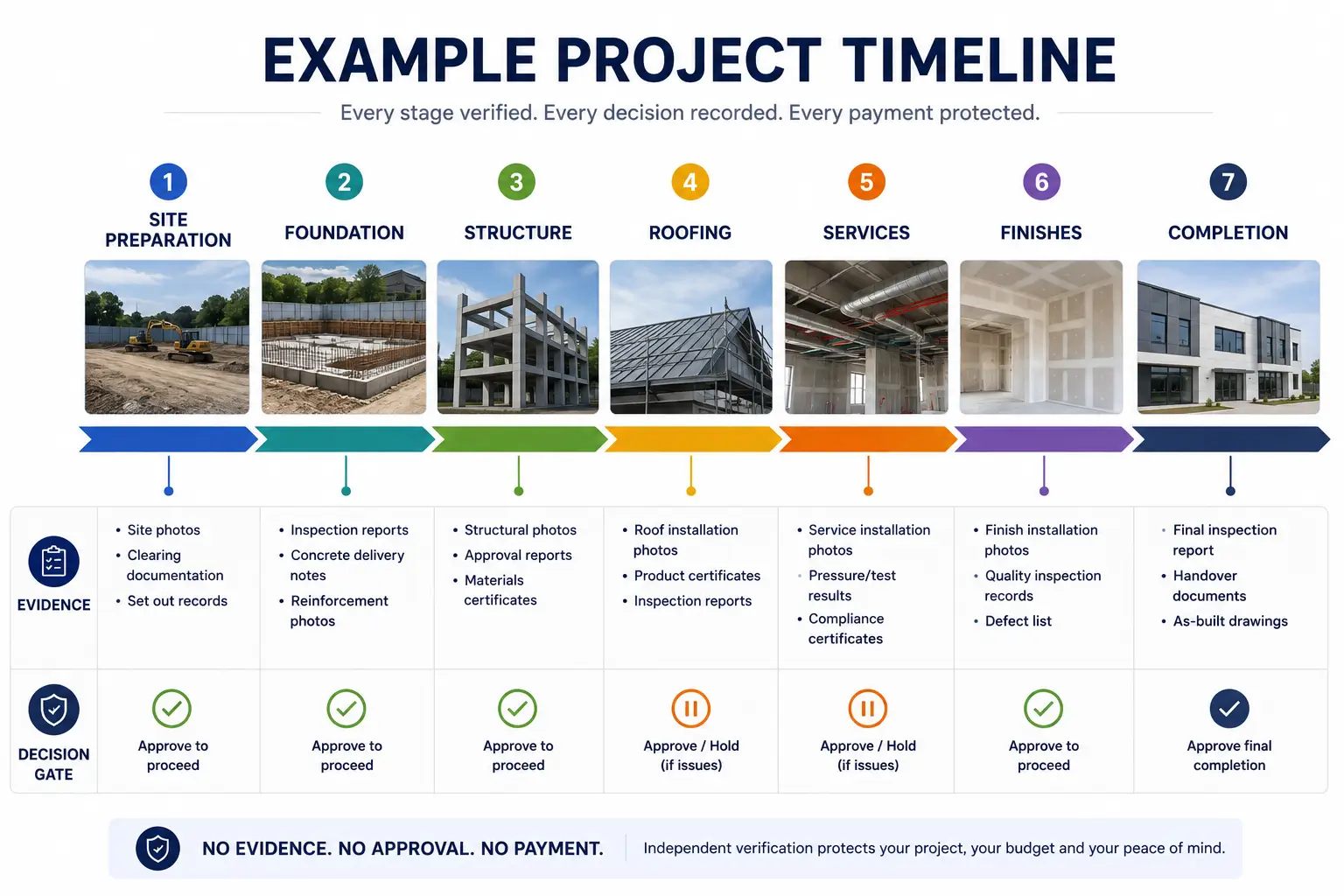
A building project may be organised around mobilisation and site preparation, substructure and foundation, structural frame, walling, roofing, first-fix services, plastering and screeding, finishes, fixtures, external works, and final completion. This should not be treated as a technical certification checklist; qualified professionals should define the specific technical acceptance requirements for each stage.
Make milestones measurable
For each milestone, write down the scope included, the responsible party, the planned date, the evidence expected, whether professional review is required, whether a client decision is required, and the payment consequence attached to it. This single habit turns a vague construction programme into a real management tool the owner can actually use.
Do not hide incomplete work inside percentages
"Foundation 90% complete" sounds precise but may be hiding the more important 10 percent that is still outstanding. Ask what specifically remains and whether it blocks the next activity from starting safely. A percentage is only useful when the underlying scope behind it is clearly defined in the first place.
It also helps to ask what the remaining percentage would cost and how long it would take, since a small remaining scope can sometimes hide a disproportionately expensive or time-consuming task.
Connect milestones to documentation
Attach drawings, photographs, reports, delivery records, test results or approvals to each milestone as it is reached. The goal is to preserve the story of why the project moved forward at each stage --- not just that it did --- so the reasoning behind a decision can still be understood months later.
Use milestones to reduce remote-owner anxiety
A remote owner does not need hundreds of random updates arriving at unpredictable intervals. They need to know: what stage the project is at, what was completed, what remains, what issue needs attention, and what comes next. Well-defined milestones, tracked consistently, make that level of clarity possible without constant back-and-forth.
Quick Checklist
-
A milestone is not just a date
-
Typical milestone groups
-
Make milestones measurable
-
Do not hide incomplete work inside percentages
-
Connect milestones to documentation
Frequently Asked Questions
Should payments always be tied to milestones?
They can be, but the payment structure should match the contract and the project. Some payments relate to mobilisation, materials, or measured work rather than a completed stage.
Who decides whether a technical milestone is complete?
Where technical certification or professional judgement is required, the appropriate qualified professional should make that determination, not the coordinator or the owner.
How many milestones should a typical project have?
There is no fixed number. Enough to give the owner meaningful visibility at each major change of activity, without creating so many that tracking them becomes its own burden.
Building Remotely?
RBP's COORDINATE and DOCUMENT steps help translate a construction programme into trackable milestones with attached evidence, so a remote owner always knows exactly where the project genuinely stands.
Related Reading
Editorial note: These articles are educational resources, not legal, architectural, engineering, quantity surveying, or other regulated professional advice. Where specialist judgement is required, readers should engage the appropriately qualified professional.
Have a question about your own project?
Every build is different. Talk it through with us directly.