While You're Building
Before You Pay: How to Verify Construction Progress and Payment Requests
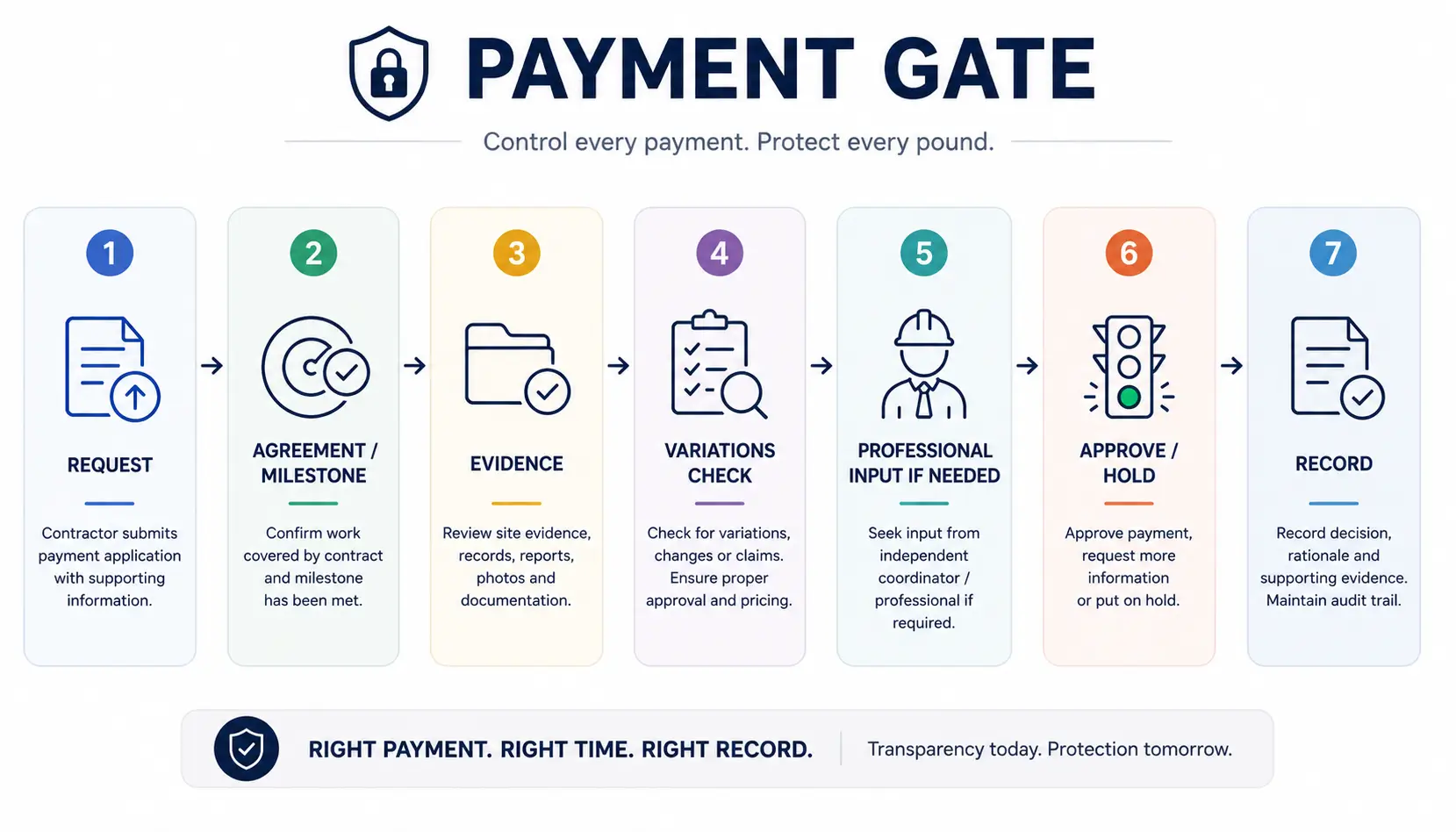
Before paying a construction request, connect the amount to an agreed scope or milestone, check supporting evidence, confirm approved variations, identify what remains incomplete, and obtain appropriate professional valuation where the payment requires specialist certification.
Start with the agreement
A payment request should always point back to something already agreed: a deposit, delivered materials, measured work, a milestone or an approved variation. If nobody involved can explain what the payment is actually for in one clear sentence, pause the payment until they can.
Ask for evidence that matches the request
Useful evidence may include dated site photographs, delivery notes, invoices, measurements, progress records and confirmation from the relevant project party. Photos alone can mislead if they are undated, selective, or simply unrelated to the specific amount being requested --- a striking image of general activity is not proof of the particular claim attached to it.
Separate materials from completed work
Materials purchased are not the same as materials delivered, and delivered materials are not the same as installed, completed work. Your payment process should always know exactly which one of these it is funding at any given point. For high-value materials, verify description, quantity, condition and site presence where practical, before treating the purchase as equivalent to progress.
Check variations before paying them
If a request includes extra work, locate the approved variation first. Confirm what changed, who authorised it, and the agreed cost basis for the change. Repeated "small extras" without a matching paper trail are one of the easiest and least dramatic ways for a project budget to drift far beyond its original plan.
Know when professional valuation is required
Some payment assessments require technical measurement, valuation or certification that goes beyond ordinary record-keeping. Use the appropriate qualified professional for that specific work. Independent coordination can organise evidence and flag inconsistencies for review, but it should never claim a regulated professional certification it is not qualified to provide.
Use a simple payment verification record
Record the request date, amount, purpose, supporting evidence, related milestone, any exceptions noted, the approval decision, who paid, and the payment reference. This single habit creates an audit trail that makes later disputes far easier to understand --- for you, for your professionals, and for anyone reviewing the project afterward.
Over a full project, this record also becomes a useful sense-check on its own: if the total paid so far is well ahead of the proportion of work actually verified as complete, that gap is worth investigating before the next request arrives, not after.
Quick Checklist
-
Start with the agreement
-
Ask for evidence that matches the request
-
Separate materials from completed work
-
Check variations before paying them
-
Know when professional valuation is required
-
Use a simple payment verification record
Frequently Asked Questions
Should I pay because the contractor says workers are waiting?
Urgency can be real, but it should not replace agreed payment controls. Verify what the specific request relates to and document the decision either way.
Can site photos prove the amount due?
They can support a decision, but on their own they may not establish quantities, value or technical completion with enough certainty to justify payment.
What if the contractor refuses to itemise a payment request?
Treat this as a warning sign. A legitimate request can normally be broken down into what it covers; reluctance to do so is a reason to slow down, not proceed.
Building Remotely?
If you are funding a project remotely, RBP's VERIFY and DOCUMENT steps can help organise the evidence and coordination around payment decisions. It does not replace professional valuation where one is required.
Related Reading
Editorial note: These articles are educational resources, not legal, architectural, engineering, quantity surveying, or other regulated professional advice. Where specialist judgement is required, readers should engage the appropriately qualified professional.
Have a question about your own project?
Every build is different. Talk it through with us directly.