While You're Building
How to Verify Building Materials Delivered to Your Construction Site
Verify a material delivery by checking the purchase order against what arrived: product description, brand/specification, quantity, condition, delivery date, vehicle or supplier details, and supporting photos or video. Record discrepancies before the materials are used.
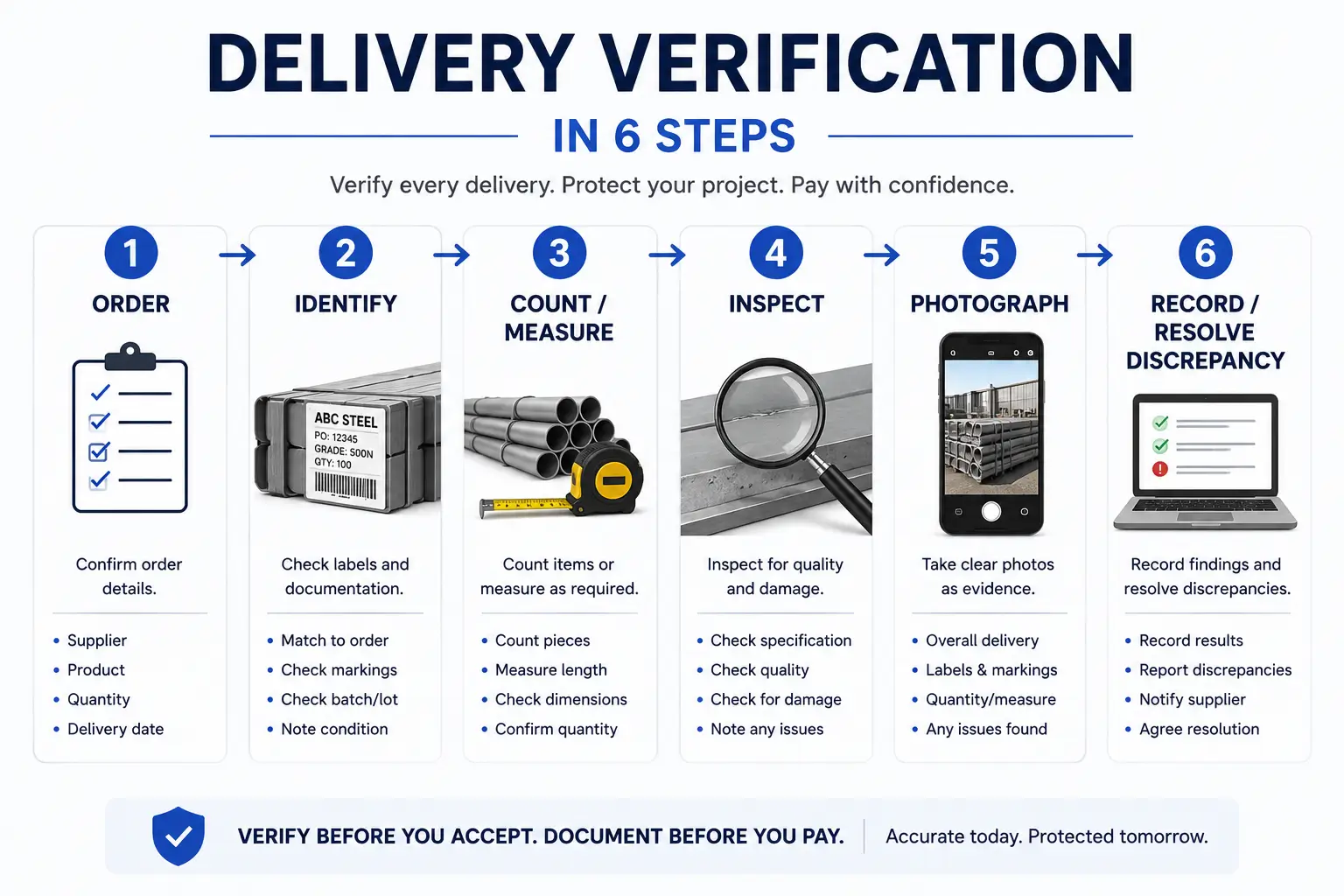
Verify against an order, not memory
Before the truck arrives, the person receiving the delivery should already have the order or a clear delivery expectation in hand. It should state the product, size or grade where relevant, brand if specified, quantity and unit. Without that written baseline, a claim that "everything arrived" is very difficult to prove after the fact.
Check identity and specification
Look beyond the product name on the delivery note. Roofing sheets vary by profile, thickness and finish. Reinforcement varies by diameter and specification. Tiles vary by size, finish, shade or batch and carton coverage. Cement and other manufactured products should be sourced through credible channels, with relevant conformity markings or certification checked where applicable.
A useful habit is photographing the manufacturer's markings on the product itself, not only the packaging, since packaging can sometimes be reused or mismatched with the contents it now holds.
Count or measure intelligently
Use the correct unit for the material: bags, pieces, lengths, bundles, tonnes, cartons or square metres. For packaged products, record carton or bag counts precisely and inspect any damaged packaging before accepting the load. Where weight or a technical measurement is material to the transaction, use appropriate measurement evidence rather than an estimate by eye.
Document condition before acceptance
Photograph the load, the product labels, any damaged items and the storage location the materials are moved to. Record the date and time clearly. If there is a shortage or a substitution, notify the supplier promptly and keep the affected items identifiable and separate until the matter is resolved.
Control what happens after delivery
Delivery verification is only the first control, not the last. Record where materials are stored on site and who is authorised to issue them for use. A perfectly verified delivery can still disappear through poor site inventory control in the weeks that follow --- the two problems are different, and both need their own safeguard.
Use standards as a quality reference
The Standards Organisation of Nigeria develops and administers standards and conformity-assessment programmes. SON's MANCAP scheme is intended to ensure locally manufactured products conform to relevant Nigerian Industrial Standards before sale. Product certification is a useful reference point, but it does not remove the need to check that the actual delivered product matches your specific order.
Quick Checklist
-
Verify against an order, not memory
-
Check identity and specification
-
Count or measure intelligently
-
Document condition before acceptance
-
Control what happens after delivery
-
Use standards as a quality reference
Frequently Asked Questions
Are delivery photos enough?
No. Combine photos with order details, quantities, labels or specifications, delivery documentation and a clear discrepancy record where anything does not match.
What should I do if the brand is different?
Do not assume it is an acceptable equivalent. Compare it against the approved specification and obtain the appropriate approval before it is used on site.
Who should physically check a delivery on a remote project?
Ideally someone independent of the person who placed the order, so the check, and the purchase are not made by the same interested party.
Building Remotely?
Material delivery verification is one of the core areas covered by RBP's VERIFY step, giving remote owners documented site evidence and independent coordination around what actually arrives on their project.
Related Reading
Sources & Verification
-
Standards Organisation of Nigeria - National Product Certification --- Official/source page
-
SON - MANCAP --- Official/source page
Editorial note: These articles are educational resources, not legal, architectural, engineering, quantity surveying, or other regulated professional advice. Where specialist judgement is required, readers should engage the appropriately qualified professional.
Have a question about your own project?
Every build is different. Talk it through with us directly.