While You're Building
How to Read a Construction Progress Report: What Remote Project Owners Should Look For
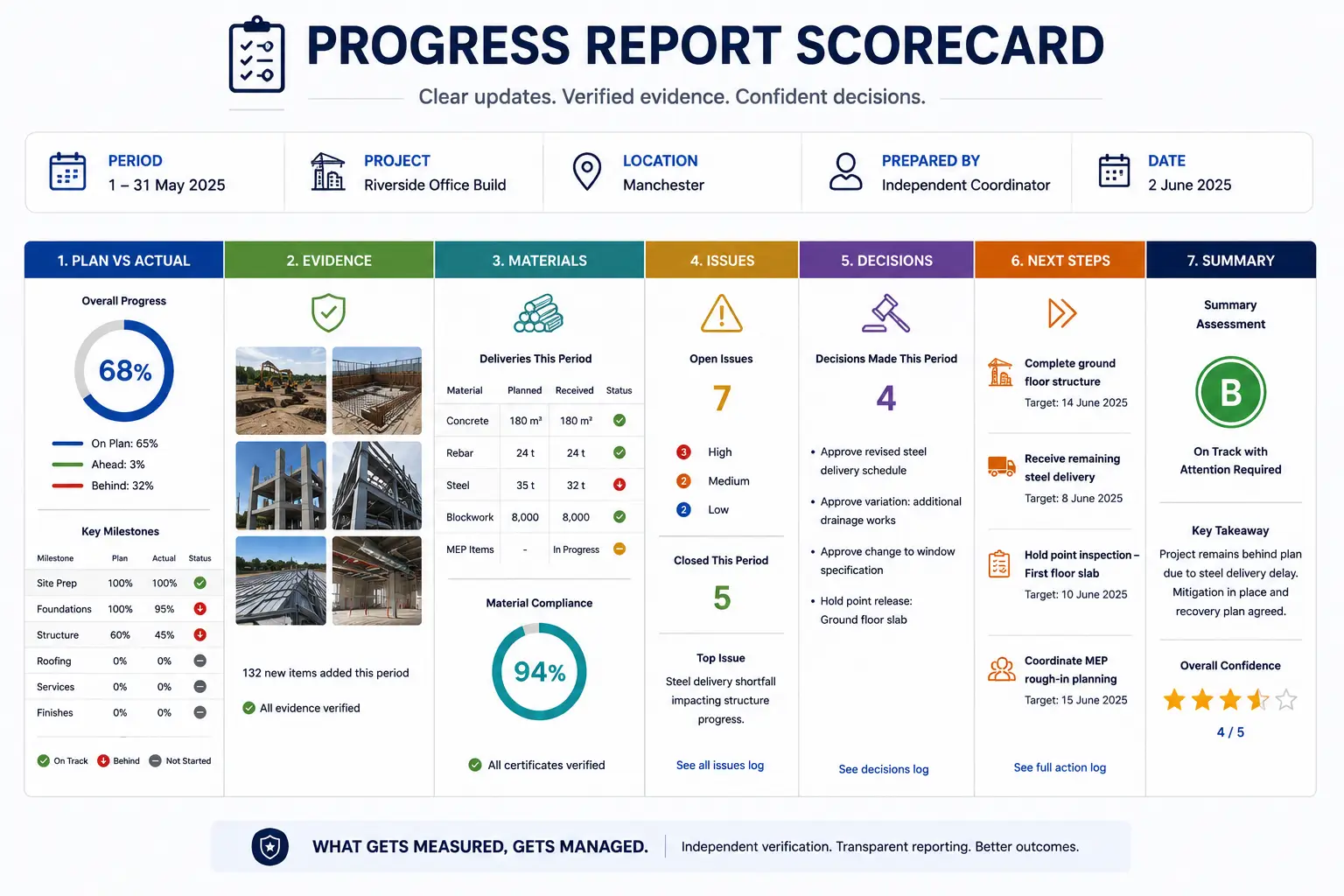
A good construction progress report should tell you what was planned, what was completed, what evidence supports it, what changed, what problems exist, what decisions are needed, and what happens next. Read for exceptions and actions, not just photographs.
Start with the reporting period
Check the dates covered and the construction stage the report refers to. A report without a clearly stated period makes it genuinely difficult to compare progress from one update to the next, or to notice when the same issue is quietly rolling over unresolved from one report to another.
Compare planned work with actual work
Look for a simple, explicit plan-versus-actual statement. What was expected to happen this period? What was actually completed? If something slipped, why did it slip, and what is the recovery plan to get back on track? A report that skips this comparison is telling you less than it appears to.
Read photographs as evidence, not decoration
Useful photos are dated, labelled, and tied clearly to a specific location or activity. Repeated wide shots of general site activity can make a report look busy while actually hiding the important detail. Ask directly whether the images provided genuinely support the written claim, or simply accompany it.
Focus on issues and decisions
The most valuable section of any report is often the least attractive one: delays, defects, missing information, material shortages, access problems, variations, and decisions that need your input. A report that says everything is fine every single week may not actually be telling you enough about what is really happening on site.
If a report has said "no issues" for several consecutive periods on an active site, that itself is worth a direct question --- genuinely trouble-free stretches happen, but so does under-reporting.
Check money and materials separately
If the report mentions payment or deliveries, look for the supporting record behind that mention. Progress, material delivery, and the amount due are related but not identical concepts. Avoid assuming that visible activity in a photo automatically proves that a particular payment value is justified.
End with next steps
A good report should identify the upcoming work, the responsible parties, target dates, and any action required from you as the owner. You should finish reading a report knowing what the project needs next, not simply a summary of what happened over the past week.
Quick Checklist
-
Check the reporting period
-
Compare planned work with actual work
-
Read photographs as evidence, not decoration
-
Focus on issues and decisions
-
Check money and materials separately
-
Look for clear next steps
Frequently Asked Questions
How often should I receive a progress report?
Frequency should match the project's pace, risk, and service agreement. Weekly reporting is common for active work, but milestone- or event-based reporting can also be useful.
What is the biggest warning sign in a report?
Repeated claims without specific evidence, unresolved issues that quietly disappear from later reports, or no clear explanation offered for delays and variations.
Should I request a call in addition to written reports?
A brief call can help you ask follow-up questions in real time, but treat it as a supplement to the written, evidence-based record, not a replacement for it.
Building Remotely?
RBP's reporting philosophy is evidence-led: help the owner understand what happened, what it means, and what action is required --- not simply deliver another folder of undated site photos.
Related Reading
Editorial note: These articles are educational resources, not legal, architectural, engineering, quantity surveying, or other regulated professional advice. Where specialist judgement is required, readers should engage the appropriately qualified professional.
Have a question about your own project?
Every build is different. Talk it through with us directly.