While You're Building
How to Maintain Construction Quality When You're Building Remotely
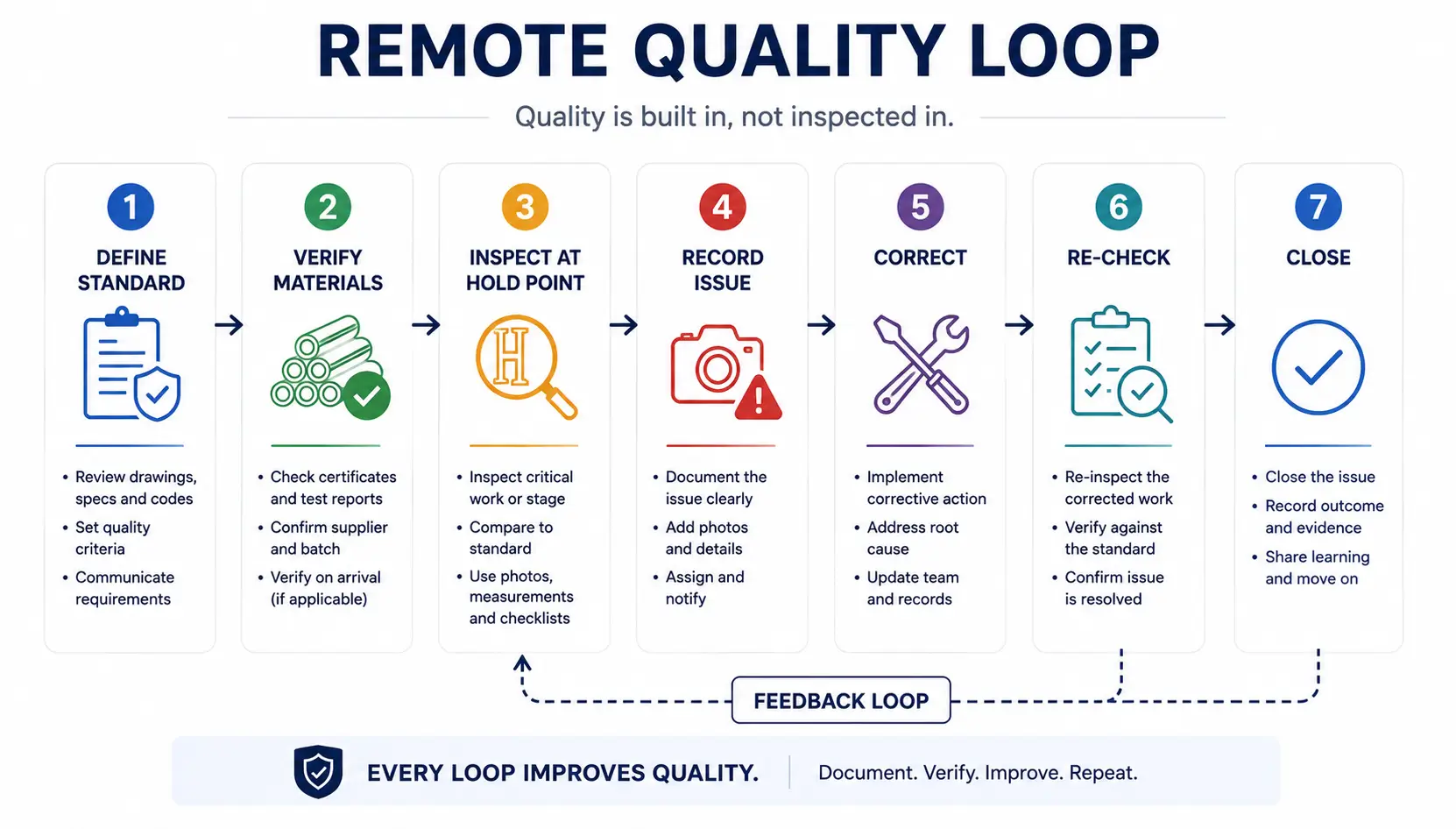
Remote construction quality control depends on approved information, qualified professionals, material verification, planned inspections, documented evidence, early issue escalation, and clear correction records. Photos are useful, but quality cannot be managed by photos alone.
Define quality before work starts
Quality begins with drawings, specifications and clearly agreed workmanship expectations, set before the first block is laid. If nobody on the project can point to a document that defines what "correct" actually means for a given element, remote checking quickly becomes subjective --- a disagreement about opinion rather than a comparison against a standard.
Use the right professional at the right stage
Structural, architectural, services and cost issues can each require a different kind of expertise. Nigeria has regulators for architects, engineers, quantity surveyors and builders. Verify the relevant practitioner for the issue at hand, and make sure technical decisions are made by people actually qualified to make them, rather than by whoever is available on site that day.
Inspect before work becomes hidden
Some defects are far harder to assess once concrete is poured, plaster covers services, or ceilings close off access. The project team should identify hold points in advance --- specific stages where relevant work is reviewed and signed off before the next activity conceals it from view entirely.
Reinforcement fixing before a concrete pour is one of the clearest examples: once concrete covers the steel, verifying bar size, spacing and cover requires far more effort than a five-minute check beforehand would have taken.
Verify materials before installation
Check that delivered products match approved specifications before they disappear permanently into the building. SON maintains Nigerian standards and product-conformity systems for many manufactured products. Any substitution should be documented and approved appropriately in advance, rather than discovered only after installation, when correction is far more disruptive and expensive.
Turn observations into actions
A genuinely useful quality record states what was observed, where it occurred, the supporting evidence, who needs to respond, the expected corrective action, and whether the issue was later closed out. A gallery of defect photos with no follow-up attached is not quality control --- it is simply documentation of a problem nobody resolved.
Do not confuse remote visibility with a guarantee
No coordination platform can guarantee a defect-free building. The realistic goal is to reduce information gaps, catch problems earlier than they would otherwise surface, and make sure the appropriate people address them promptly. Specialist testing or certification should always be handled by qualified professionals when the situation requires it.
Quick Checklist
-
Define quality before work starts
-
Use the right professional at the right stage
-
Inspect before work becomes hidden
-
Verify materials before installation
-
Turn observations into actions
-
Do not confuse remote visibility with a guarantee
Frequently Asked Questions
Can video calls replace site inspections?
They can support communication, but they cannot reliably replace every physical inspection, measurement, test or professional assessment a project may need.
What should I ask for after a defect is corrected?
Ask for clear evidence of the correction and, where appropriate, confirmation from the responsible qualified professional that the corrective work is acceptable.
How do I know which stages need a hold point?
Ask your engineer or builder to identify, at the start of the project, which activities become difficult or impossible to verify once the next stage of work covers them.
Building Remotely?
RBP can support the coordination and documentation layer of remote quality management --- organising hold-point visits and evidence --- while specialist professional assessments remain with appropriately qualified practitioners.
Related Reading
Sources & Verification
-
SON - National Product Certification --- Official/source page
-
SON - Civil/Building Standards catalogue --- Official/source page
-
ARCON/COREN/QSRBN/CORBON verification resources --- Official/source page
Editorial note: These articles are educational resources, not legal, architectural, engineering, quantity surveying, or other regulated professional advice. Where specialist judgement is required, readers should engage the appropriately qualified professional.
Have a question about your own project?
Every build is different. Talk it through with us directly.