Before You Build
Documents You Should Have Before Starting a Building Project in Nigeria
Before construction starts, organise proof of ownership, approved drawings and permits, professional designs, cost documents, contracts, project schedule, specifications, payment records, and a clear document-control system. Missing paperwork creates expensive uncertainty later, and it is far cheaper to build the habit early than to reconstruct it under pressure.
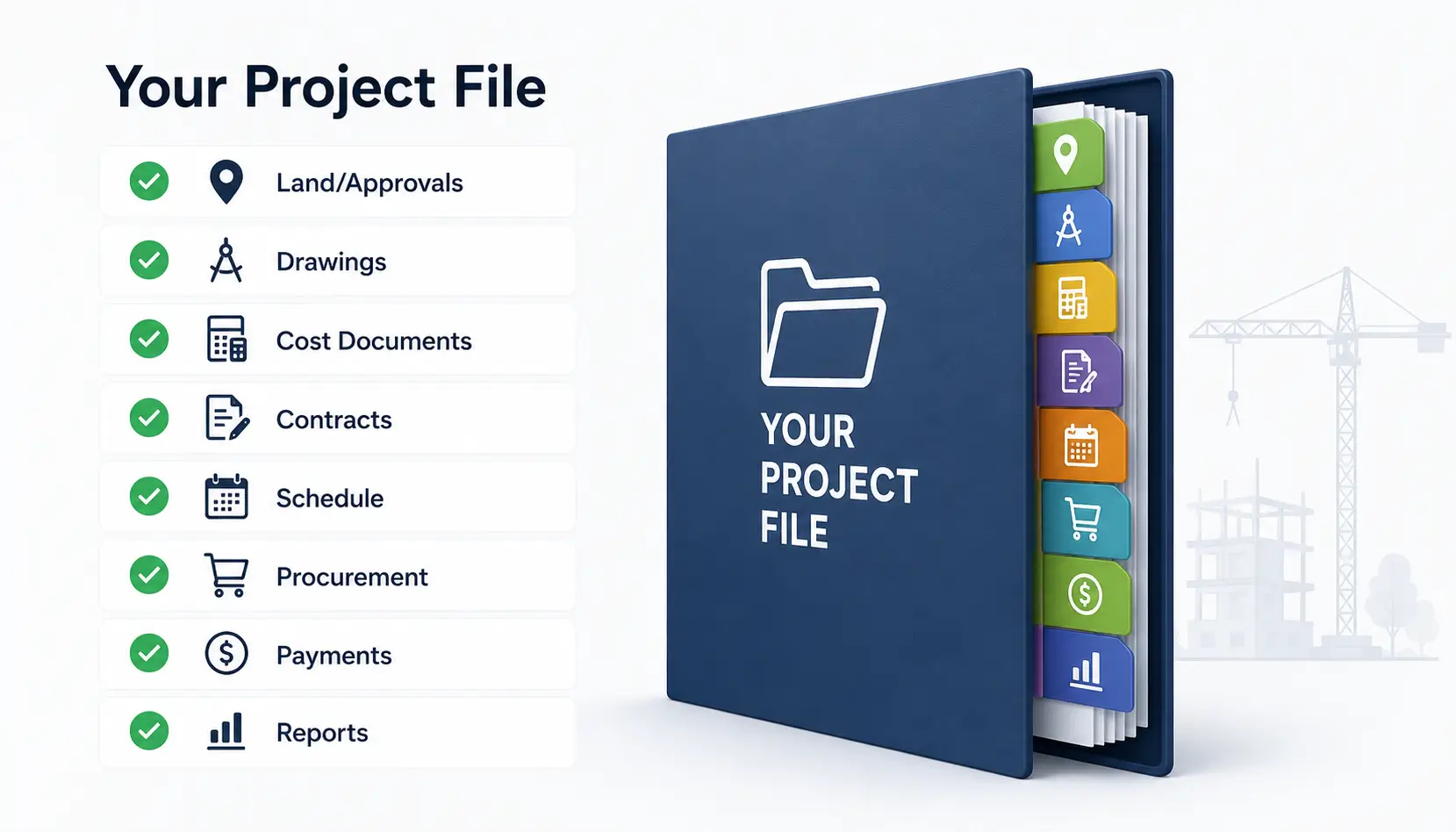
Create one project file before site work begins
Remote projects become difficult to manage when drawings sit on one phone, receipts on another, approvals with a relative, and contractor instructions are scattered across WhatsApp chats. Create one controlled project folder --- physical or cloud-based --- before groundbreaking. Use clear file names, dates and version numbers from day one, because retrofitting order onto months of scattered files is far harder than starting organised.
A practical starting point is a shared cloud folder with view-only access for most people and edit access limited to one or two trusted individuals, so the record cannot be quietly altered after a disagreement.
Land and approval documents
Keep the documents that establish your interest in the land, together with any planning or development approvals the project requires. Approval requirements vary by location and project type, so confirm the specific requirements with the relevant local planning authority and your qualified professionals rather than assuming your project matches a neighbour's experience.
ARCON describes building-plan approval as a mandatory pre-construction process, and notes that a submission may include architectural designs, structural drawings and other required documents. Treat the approval file as living --- update it whenever an amendment is submitted or granted.
Design and technical documents
Keep the current architectural drawings, structural information, services drawings where applicable, schedules and specifications. Mark old versions clearly as superseded rather than deleting them, since a dispute may later need to show what changed and when. A site team building from an outdated drawing can create a very expensive correction --- sometimes discovered only after the work is already covered.
Cost and procurement records
Your cost file may include a bill or schedule of quantities, estimates, quotations, purchase orders, invoices, delivery notes and receipts. The important rule is traceability: you should always be able to connect a payment back to something that was specifically ordered, delivered or completed, rather than to a general sense that "work is progressing".
Contracts, programme and communication records
Keep signed agreements showing scope, price basis, payment terms, the variation procedure, responsibilities and the dispute process. Keep the project programme and milestone expectations alongside it. Important instructions should be captured in writing even when the conversation started by phone --- a short follow-up message confirming what was agreed protects everyone involved.
Use a simple document register
Create columns for document name, version and date, prepared by, approved by, current status and storage link. For a remote owner, this register becomes the map to the entire project record --- the single place you check before asking "do we have this?" Back up critical files in secure cloud storage and control who has permission to edit them.
Review the register at each reporting cycle, not only when something goes wrong. A five-minute check-in that a new drawing revision or invoice has actually been filed is far cheaper than discovering a gap in the record during a dispute.
Quick Checklist
-
One project file before site work begins
-
Land and approval documents
-
Design and technical documents
-
Cost and procurement records
-
Contracts, programme and communication records
-
A simple document register
Frequently Asked Questions
Should I start while approval is still processing?
Do not assume you can. Confirm the applicable requirements with the relevant planning authority and your qualified project professionals before any physical work begins.
Are WhatsApp messages enough project documentation?
They are useful as communication records, but important approvals, variations, payment decisions and technical instructions should also be captured in a clearer, controlled record that can be searched later.
Who should hold the master copy of project documents?
The owner, or an independent party acting on the owner's behalf, should hold the master copy. Relying on a contractor's own files as the only record leaves the owner without an independent reference if a disagreement arises.
Building Remotely?
Document control is the foundation of RBP's DOCUMENT step. For a remote build, RBP can help set up and maintain a structured project file so nothing important depends on one phone or one relative's memory.
Related Reading
-
How to Choose the Right Professionals for Your Building Project in Nigeria
-
How to Prepare a Realistic Construction Budget Before You Start Building
Sources & Verification
- ARCON - Building Plan Approval: A Crucial Step in the Construction Process --- Official/source page
Editorial note: These articles are educational resources, not legal, architectural, engineering, quantity surveying, or other regulated professional advice. Where specialist judgement is required, readers should engage the appropriately qualified professional.
Have a question about your own project?
Every build is different. Talk it through with us directly.