Before You Build
How to Prepare a Realistic Construction Budget Before You Start Building
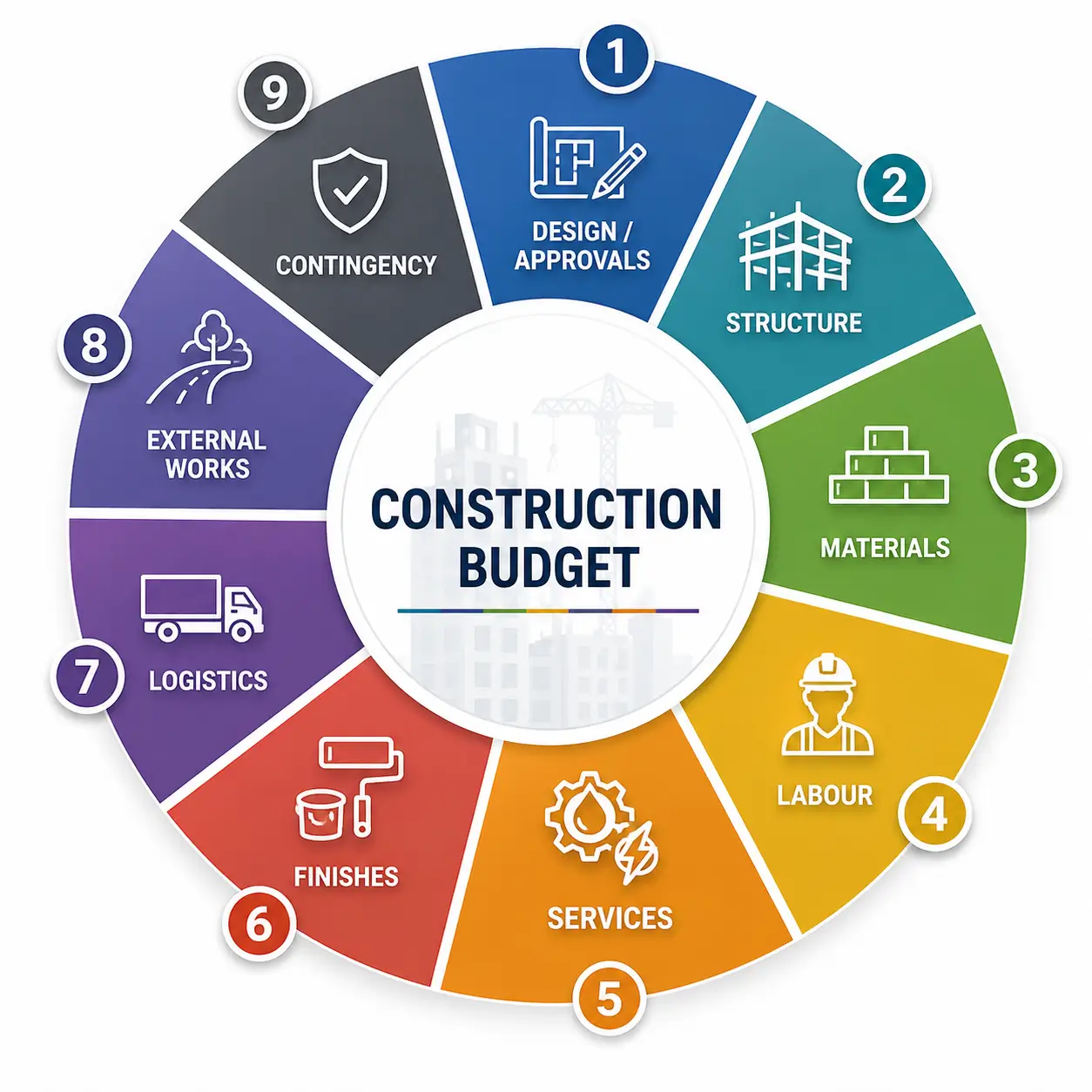
A realistic construction budget is more than the cost of blocks, cement, and labour. It should cover professional inputs, approvals, preliminaries, materials, labour, logistics, services, finishes, contingencies, and a controlled allowance for changes.
Budget from scope, not from hope
Start with what you actually intend to build: size, number of floors, specification level, location, site conditions and desired finish. A friend's cost figure from two years ago, or from a different state, is not your budget. Prices, transport distances, design choices and site conditions all differ, sometimes significantly, between two projects that sound similar in conversation.
"Hope" budgeting often shows up as a single round number --- five hundred, ten, thirty million naira --- repeated confidently without a scope behind it. If you cannot point to the drawing or specification that produced the figure, treat it as a placeholder, not a plan.
Separate the budget into cost buckets
Use clear headings: land-related and site costs, design and approvals, preliminaries, substructure, frame, walls, roofing, mechanical and electrical services, finishes, external works, professional services, logistics and contingency. Breaking the budget into buckets makes overruns visible early, in the specific area where they are happening, instead of hiding them inside one large, opaque figure that only tells you the total is wrong after the fact.
Get quantities and assumptions checked
For meaningful cost planning, use appropriate professional input. Quantity surveying is a regulated profession in Nigeria, and QSRBN is responsible for regulating its practice. Simple online estimators --- including SonOfMan Integrated's own Smart Estimator --- can help with early, indicative planning, but they should not be presented as a substitute for professional cost advice once a project moves beyond the sketch stage.
Build a contingency deliberately
Contingency is not spare money to spend early on upgrades. It exists to protect the project against genuine uncertainty --- ground conditions, price movements, design development and unforeseen site issues. The right amount depends on how complete the design is, site risk, price volatility and overall project complexity. Record what the contingency is used for, line by line, so it does not quietly disappear into general spending before it is actually needed.
Plan cash flow, not only total cost
A project can have an entirely adequate total budget and still stall because cash arrives at the wrong time relative to when it is needed. Map expected payments to construction milestones and procurement lead times well in advance. Avoid buying expensive items too early without secure storage in place, but also avoid waiting until a critical material is the thing stopping work on site.
For diaspora owners, this mapping matters even more, since international transfers, exchange-rate timing and banking processes can add days of delay that a same-city owner would never notice. Build that lag into the schedule rather than discovering it the week a payment is due.
Control changes after the budget is approved
Every proposed change should answer three questions before it is agreed: What changes? What does it cost? What does it do to the programme? Small upgrades repeated across tiles, doors, sanitary ware and fittings can quietly destroy a budget without any single dramatic overspend --- which is exactly why each one deserves the same discipline as a major decision.
Quick Checklist
-
Budget from scope, not from hope
-
Separate the budget into cost buckets
-
Get quantities and assumptions checked
-
Build a contingency deliberately
-
Plan cash flow, not only total cost
-
Control changes after the budget is approved
Frequently Asked Questions
Can I use a construction calculator as my final budget?
Use calculators for early planning and sense-checking. Complex project costing should be based on project-specific information and appropriate professional input, particularly once drawings are finalised.
What causes budgets to fail most often?
Incomplete scope, weak quantities, uncontrolled variations, missing logistics and preliminaries, unrealistic prices, and paying without linking money to verified progress are among the most common causes.
Should contingency be a fixed percentage?
A percentage is a common starting point, but the right figure should reflect the actual risk profile of the project --- an unusual site, an incomplete design, or a volatile material market may justify a higher allowance than a standard rule of thumb.
Building Remotely?
If you are planning materials, SonOfMan Integrated's Smart Estimator can help with early quantity planning. For a remote, live project, RBP's COORDINATE and DOCUMENT steps can help organise documented project visibility around milestones and payments as the budget is spent.
Related Reading
-
How to Choose the Right Professionals for Your Building Project in Nigeria
-
Documents You Should Have Before Starting a Building Project in Nigeria
Sources & Verification
- QSRBN - Quantity Surveyors Registration Board of Nigeria --- Official/source page
Editorial note: These articles are educational resources, not legal, architectural, engineering, quantity surveying, or other regulated professional advice. Where specialist judgement is required, readers should engage the appropriately qualified professional.
Have a question about your own project?
Every build is different. Talk it through with us directly.