Before You Build
How to Choose the Right Professionals for Your Building Project in Nigeria
Choose construction professionals by matching each role to the work, checking registration where applicable, reviewing relevant experience, agreeing responsibilities in writing, and avoiding one person who claims to handle every specialist function. Getting this decision right, before any money moves, shapes almost everything that follows on the project.
Start with the role, not the person
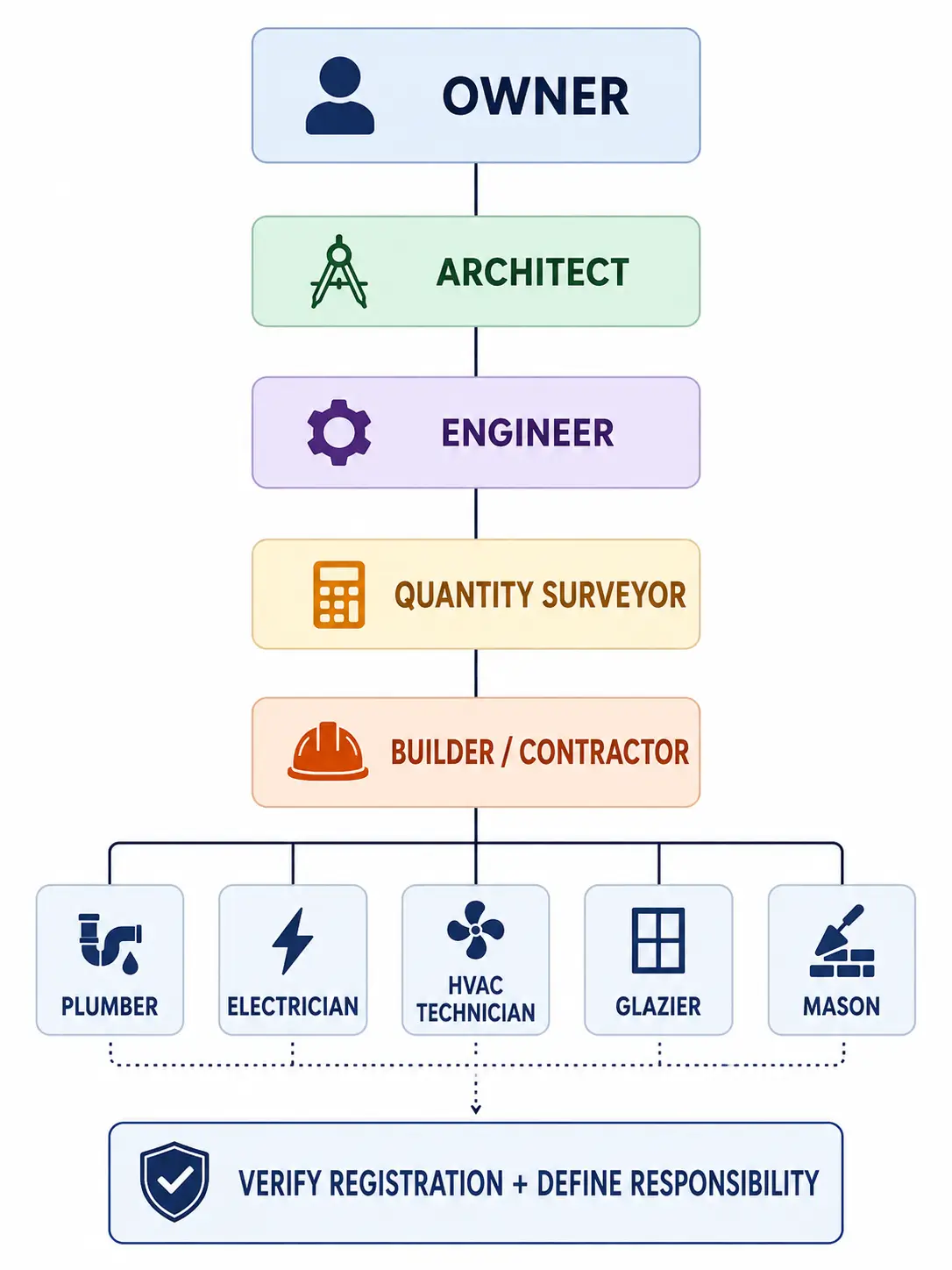
A safe building team starts with clear roles, not a favourite contact. An architect develops and coordinates design. A structural or civil engineer handles engineering design, loading and technical calculations. A quantity surveyor focuses on cost planning, measurement and value. A registered builder is concerned with building production and site management. Depending on the project, you may also need a land surveyor, an MEP consultant for mechanical and electrical services, or specialist trades.
Even a modest bungalow usually touches three or four distinct competencies, whether or not one firm coordinates them for you. The common mistake remote owners make is hiring one trusted contact and quietly allowing that person to become designer, estimator, contractor, buyer and verifier at the same time. Convenience is not the same as control. Separate important responsibilities where the project's size, cost or risk justifies it.
This mistake is especially common when the trusted contact is a relative or a family friend. Trust in the relationship is not the same as competence in every discipline, and asking a familiar person to "just handle everything" often means nobody is actually checking anybody else's work --- including the trusted contact's own.
How do you verify construction professionals in Nigeria?
Ask for the professional's full name, registration number, firm name and current practice status where applicable. Nigeria has statutory regulators for key professions: ARCON provides an architect or firm lookup, COREN provides real-time verification for engineering practitioners and firms, QSRBN regulates quantity surveying and maintains a register, and CORBON regulates the building profession and provides builder verification.
Do not stop at a certificate forwarded on WhatsApp. Verify independently through the relevant regulator's own portal, and check whether the registration is current rather than lapsed. Some practitioners register as a firm rather than as an individual, so search both names. Once registration is confirmed, check whether the person's actual experience matches your project's type, scale and location --- a valid licence does not by itself tell you whether someone has built anything like your house before.
Ask for evidence of relevant work
A long portfolio is less useful than three genuinely comparable projects. Ask what the professional actually did on each one, request references you can call, and ask about a problem that came up and how it was resolved --- this reveals more than a polished project list ever will. Where possible, visit a completed or ongoing project in person or through someone you trust.
For a remote build, also ask how the practice documents decisions, variations, site observations and approvals, since this is the paper trail you will depend on from a distance. Finally, ask who will physically attend your site. The senior name presented at the first meeting is not always the person handling your project week to week.
Agree responsibilities before money starts moving
Write down who prepares drawings, who prices work, who buys materials, who approves changes, who verifies progress on site and who is authorised to request payment. A simple responsibility matrix --- listing each activity against the person accountable for it --- prevents the dangerous sentence: "I thought the other person was handling it."
Attach this matrix to your engagement letter or contract, define how often you expect updates, and agree an escalation step for when something stalls. Revisit the matrix at each major project stage, since roles can quietly shift as a project moves from design into construction.
Red flags to avoid
Be cautious when someone refuses independent verification, discourages a written agreement, cannot explain their fees clearly, insists that all project money pass through one personal account, pressures you to start before approvals are in place, or becomes defensive when you ask for documentation.
The right professional does not need to know everything. A strong professional knows the limits of their own role and brings in the right specialist when the project needs one --- and welcomes scrutiny, because clear roles and written records protect competent people as much as they protect the owner.
Quick Checklist
-
Start with the role, not the person
-
Verify construction professionals through the relevant Nigerian regulator
-
Ask for evidence of relevant work
-
Agree responsibilities before money starts moving
-
Watch for red flags
Frequently Asked Questions
Can one person manage my whole building project?
One person may coordinate several activities, but specialist design, engineering, cost and regulated professional responsibilities should remain with appropriately qualified people who can each be verified independently.
Is professional registration enough?
No. Registration confirms professional standing, but you should still assess relevant experience, communication, capacity and references before appointing someone to your project.
Do I still need multiple professionals for a small project?
Scale changes the depth of involvement, not the underlying need. Even a small project benefits from separating design, pricing and execution, even where one practice supplies more than one of these functions through different qualified staff.
What if my relative recommends someone they have used before?
A personal recommendation is a useful starting point, not a substitute for verification. Confirm registration and relevant experience for that project independently, the same way you would for any other candidate.
Building Remotely?
If you are building from another city or country, Remote Build Protection's VERIFY step can independently confirm a professional's registration status and help you coordinate documented engagement records, without acting as the architect, engineer, quantity surveyor or builder itself. See How Remote Build Protection Works.
Related Reading
-
Documents You Should Have Before Starting a Building Project in Nigeria
-
How to Prepare a Realistic Construction Budget Before You Start Building
Sources & Verification
-
ARCON - Architect/Firm verification and building plan guidance --- Official/source page
-
COREN - Engineering practitioner verification --- Official/source page
-
QSRBN - Quantity surveying regulation and register --- Official/source page
-
CORBON - Builder regulation and verification --- Official/source page
Editorial note: These articles are educational resources, not legal, architectural, engineering, quantity surveying, or other regulated professional advice. Where specialist judgement is required, readers should engage the appropriately qualified professional.
Have a question about your own project?
Every build is different. Talk it through with us directly.