Before You Build
Construction Contracts: What Should Be Agreed Before Work Begins?
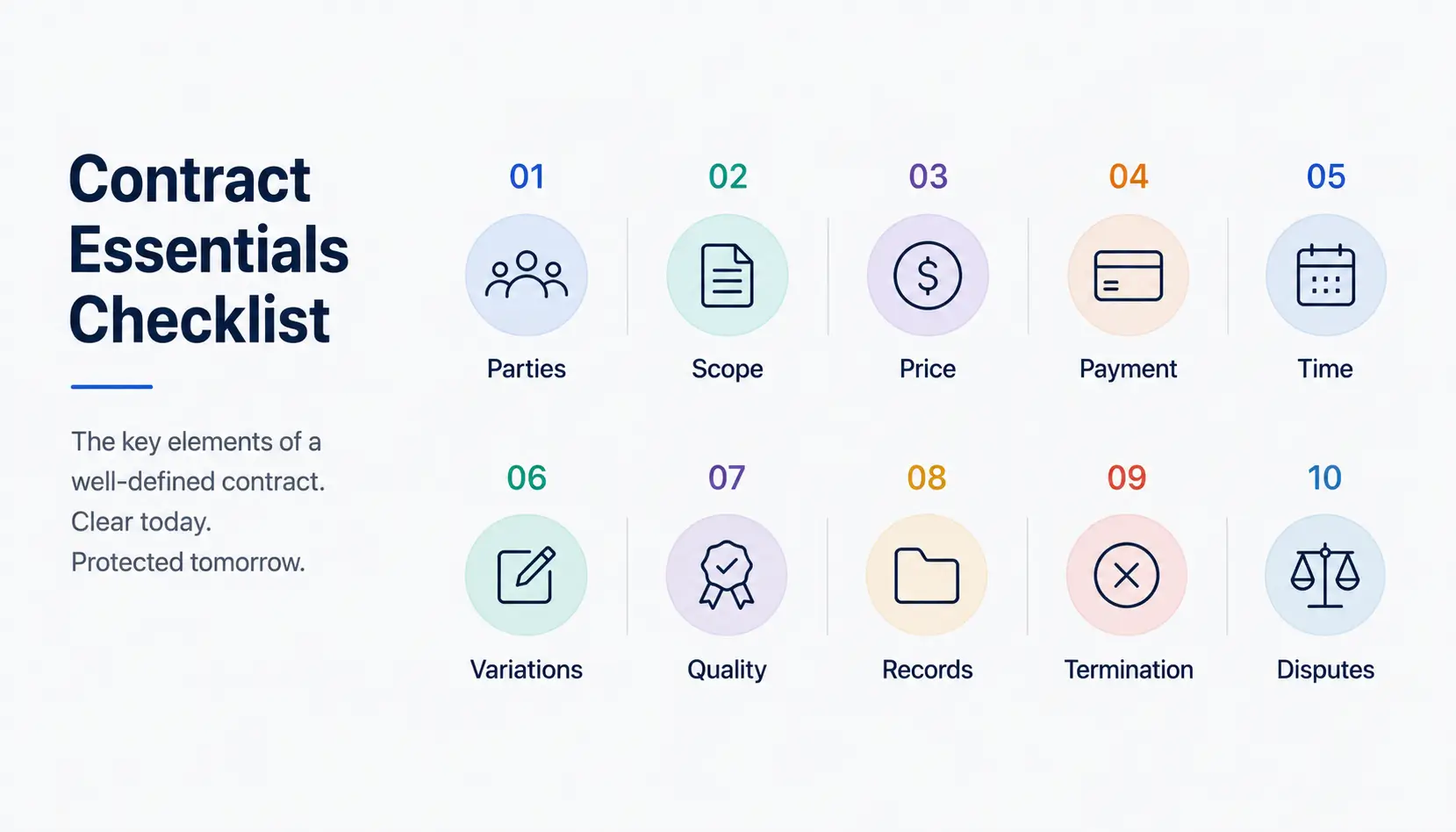
Before work begins, a construction contract should clearly state the parties, scope, drawings/specifications, price basis, payment rules, programme, responsibilities, variations, quality expectations, termination, and dispute process. The goal is to remove avoidable ambiguity before money and work begin.
A contract is a project-control tool
A contract should never be treated as paperwork you sign after everything has already been agreed verbally. It is the written reference for exactly what each party promised. For a remote owner, that reference becomes even more important, because many instructions and approvals happen without a face-to-face meeting, and memory alone cannot be relied on months later when a disagreement surfaces.
Define exactly what is included
State the work, drawings, specifications, exclusions and who supplies which materials. If a contractor says "complete roofing", define whether that includes timber or steel members, sheets, accessories, gutters, transport and labour, or whether some of these sit outside the price. Vague scope is one of the most common sources of later arguments, precisely because both sides can genuinely believe they were right.
The same discipline applies to smaller trade packages. "Plumbing complete" can mean very different things depending on whether it includes fittings, water heaters, external connections, or testing --- spell it out rather than assuming a shared understanding exists.
Link payment to clear rules
State deposit requirements, milestone payments, and the supporting documents each request must include, retention if applicable, and exactly what must be confirmed before a payment becomes due. Avoid vague payment language such as "pay as work progresses" without defining what progress actually means in measurable terms for that stage of the project.
Control variations
Changes to a building project are normal; undocumented changes are dangerous. Require a written description of the change, its price effect and its time effect, with approval obtained before work proceeds wherever practical. Keep a running variation register so that a series of small changes never quietly turns into a high, unexplained cost.
Agree communication, delay and dispute procedures
Name authorised contacts on each side. Define how notices and approvals are given. State what happens if work is delayed, suspended or terminated, and include a dispute-resolution process appropriate to the size of the agreement. Nigerian courts have enforced agreed arbitration clauses in commercial contracts, which is exactly why dispute wording should never be copied casually from an unrelated template.
Do not use a template blindly
A downloaded contract can easily miss your project's location, procurement model, professional roles and specific risks. Use templates as a starting point, then tailor them carefully to the actual project. Legal drafting and legal advice should come from a qualified Nigerian lawyer, particularly where the contract value or risk justifies the cost of that review.
Quick Checklist
-
A contract is a project-control tool
-
Define exactly what is included
-
Link payment to clear rules
-
Control variations
-
Agree on communication, delay and dispute procedures
-
Do not use a template blindly
Frequently Asked Questions
Should every small building job have a written agreement?
The formality can match the size of the job, but scope, price, payment, time and responsibility should still be recorded in writing, even in a short letter of agreement.
Can RBP draft my construction contract?
No. RBP does not present itself as a law firm. It can help coordinate and organise project records, while legal documents should always be prepared or reviewed by a qualified lawyer where appropriate.
What happens if a contract is silent on a specific situation?
Silence is a risk, not a solution. Where a contract does not address a situation clearly, resolve the gap in writing as soon as it is identified, ideally through a signed addendum, rather than relying on verbal understanding.
Building Remotely?
RBP's COORDINATE and DOCUMENT steps can help track whether agreed contract terms --- payment triggers, variation approvals, reporting frequency --- are actually being followed on site, without drafting or interpreting the legal agreement itself.
Related Reading
-
How to Choose the Right Professionals for Your Building Project in Nigeria
-
Documents You Should Have Before Starting a Building Project in Nigeria
Sources & Verification
-
ARCON - Building plan approval guidance --- Official/source page
-
Mondaq case summary - binding nature of arbitration clauses in Nigerian contracts --- Official/source page
Editorial note: These articles are educational resources, not legal, architectural, engineering, quantity surveying, or other regulated professional advice. Where specialist judgement is required, readers should engage the appropriately qualified professional.
Have a question about your own project?
Every build is different. Talk it through with us directly.