Protect Your Project
Overbilling and Inflated Quotes: How to Protect Your Construction Budget
Protect against construction overbilling by defining scope, comparing like-for-like quotations, checking quantities and rates, separating approved variations, verifying deliveries or progress, and maintaining a payment register. A low quote is not automatically fair, and a high quote is not automatically fraudulent.
Compare the same scope
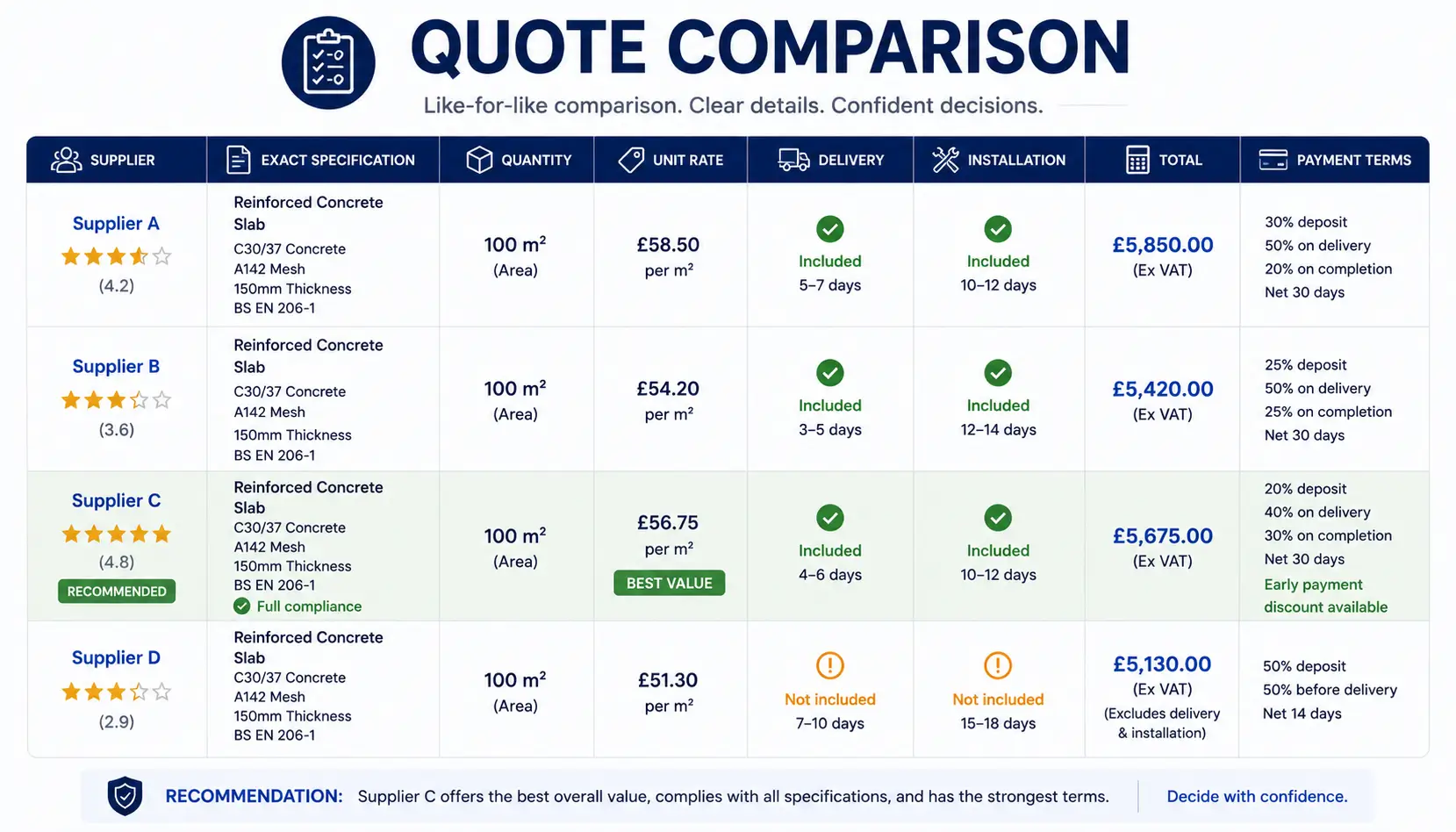
Three quotes are effectively useless if each supplier priced a different scope of work. Standardise the product description, quantity, unit, delivery location, applicable taxes, installation scope and payment terms before you compare the final totals --- otherwise you are comparing three different projects, not three prices for one project.
Separate quantity from rate
When a price looks unusually high, ask specifically whether the issue is quantity, unit rate, logistics, wastage, specification or scope. Breaking the number down this way makes the discussion factual rather than emotional. For complex measurement and valuation, involve an appropriately registered quantity surveyor rather than negotiating on instinct alone.
Watch repeated small extras
Budget damage often arrives through many small variations rather than one obviously large invoice. Maintain a running variation register showing the original scope, the change, the reason given, the amount, and whether it was formally approved --- small numbers add up quickly when nobody is tracking them together.
Verify supplier quotations where the value justifies it
For significant purchases, confirm the supplier's identity and the quotation details through an independent contact channel where practical. Be particularly cautious with last-minute account changes or invoices that cannot be clearly traced back to the actual supplier your project engaged.
Link payment to evidence
Do not pay an amount simply because it appears on a professional-looking document. Connect every payment to an order, a delivery, measured work, an agreed milestone, or an approved change, and preserve the payment reference once the transfer is made, so the trail can always be reconstructed later.
Use benchmarks carefully
Online prices and market conversations can help you sense-check a quote, but building-material prices vary meaningfully by location, quantity, specification, transport distance and timing. The objective is not always the absolute cheapest price available --- it is a defensible price for the specific, agreed requirement in front of you.
SonOfMan Integrated's own product pricing and Smart Estimator can serve as one such reference point for materials it stocks, alongside other credible quotations, rather than as the sole benchmark for every decision.
Quick Checklist
-
Compare the same scope
-
Separate quantity from rate
-
Watch repeated small extras
-
Verify supplier quotations where the value justifies it
-
Link payment to evidence
-
Use benchmarks carefully
Frequently Asked Questions
How many quotes should I collect?
There is no universal number. For significant purchases, gather enough comparable quotations to understand the market and test value, while specialised items may simply have fewer credible suppliers available.
Does an expensive quote mean someone is cheating me?
No. Investigate the scope, specification, quantity, logistics, and market conditions carefully before reaching that conclusion about anyone involved.
Should I always choose the lowest quote?
Not automatically. An unusually low quote can reflect a narrower scope, a lower specification, or an unsustainable price that leads to later claims for extra payment.
Building Remotely?
RBP can help remote owners organise quotations, delivery evidence and payment records as part of its DOCUMENT step, so decisions are based on a clearer, more defensible project trail.
Related Reading
-
Common Fraud Patterns to Watch for When Building Remotely in Nigeria
-
Material Substitution: How to Identify and Reduce the Risk on Your Building Project
Sources & Verification
- QSRBN - Regulation of quantity surveying practice --- Official/source page
Editorial note: These articles are educational resources, not legal, architectural, engineering, quantity surveying, or other regulated professional advice. Where specialist judgement is required, readers should engage the appropriately qualified professional.
Have a question about your own project?
Every build is different. Talk it through with us directly.