Protect Your Project
Common Fraud Patterns to Watch for When Building Remotely in Nigeria
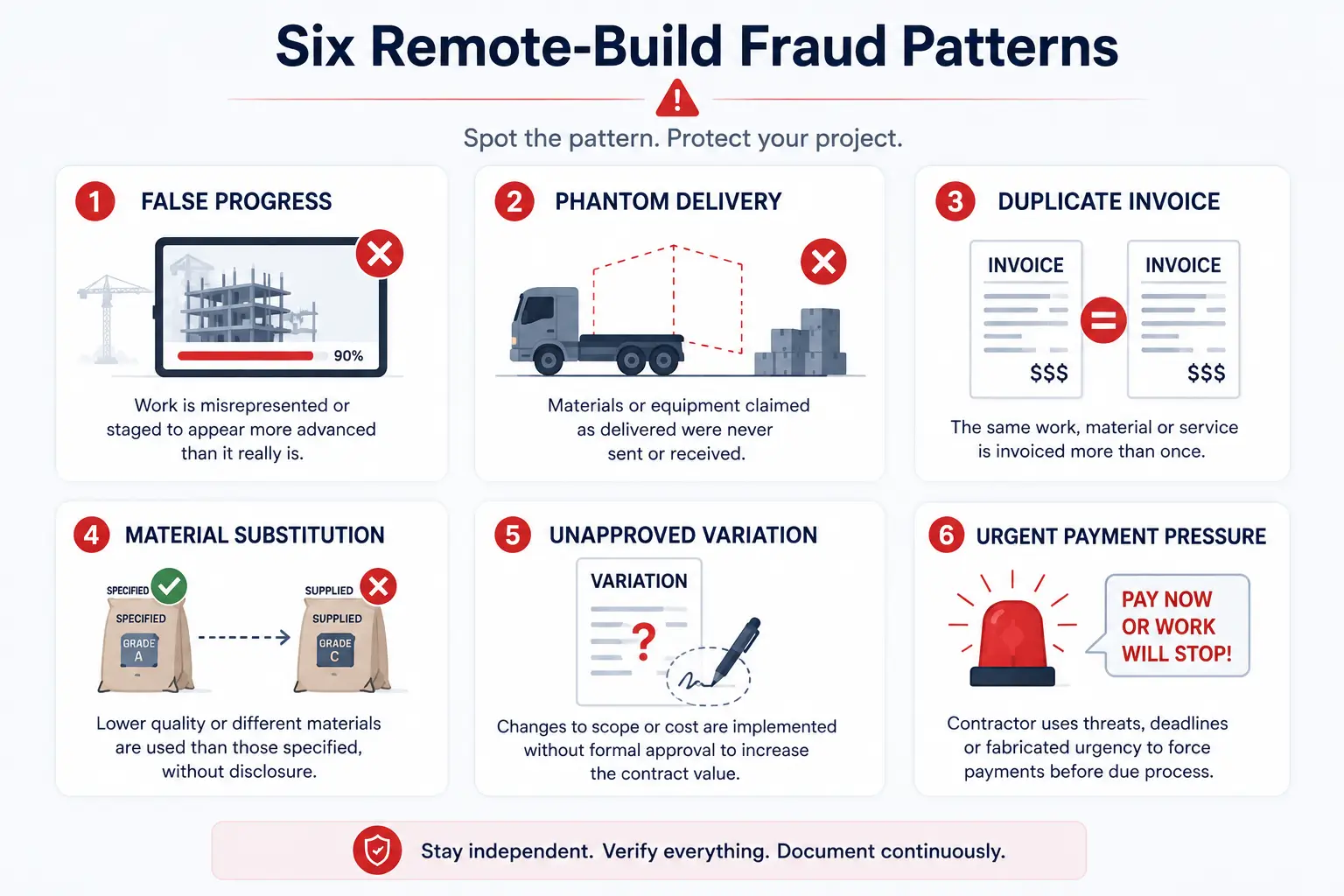
Remote building fraud often exploits information gaps: false progress claims, duplicate or inflated invoices, material substitution, phantom deliveries, unauthorised changes and pressure for urgent payments. The strongest defence is independent evidence, written controls and separation of key responsibilities.
Fraud thrives where one person controls the story
If one person requests money, buys materials, confirms delivery, reports progress, and explains away every discrepancy, the owner has almost no independent information to check any of it against. That concentration of control does not by itself prove dishonesty, but it consistently creates the opportunity for it --- which is exactly why separating these functions matters, regardless of how much you trust any one individual.
False or exaggerated progress
A payment request may claim a stage is complete when the work is genuinely only partial. Protect yourself by defining milestones clearly in advance and requiring current, identifiable evidence for each one. Where technical certification is required to confirm completion, use the appropriate qualified professional rather than accepting a verbal assurance.
Phantom or recycled deliveries
Receipts and photos can be presented convincingly without actually proving that the specified quantity reached your site. Match every delivery to its order, record labels and quantities at the point of receipt, and keep dated site evidence for anything significant. High-value deliveries --- reinforcement, roofing sheets, large cement orders --- deserve noticeably stronger controls than routine ones.
One recognisable pattern is the same load, or the same pile of blocks, appearing in near-identical photographs across two separate reporting periods. A dated, wider establishing shot each time makes this pattern far easier to notice.
Duplicate, altered or inflated invoices
Compare every new payment request against your running payment register before approving it. Keep original supplier quotations and payment references on file. When practical, verify significant supplier details independently rather than relying solely on a forwarded invoice, which can be edited far more easily than most owners assume.
Unauthorised substitution
A cheaper material may quietly be supplied while the owner is still charged for the originally specified product. Verify brand, size, grade, finish or other relevant specification before installation, not after. SON's conformity systems help with baseline product standards, but you still need to independently confirm that the delivered item matches what you actually approved.
Urgency as a control bypass
"Send money now or the workers will leave" can pressure an owner into abandoning their normal checks in a moment of stress. Genuine urgency does happen on real projects --- but your process should define in advance exactly how emergency requests are documented and approved, so urgency never becomes a routine excuse to skip verification.
Build controls, not suspicion
The goal here is not to treat every contractor or relative involved in the project as dishonest. Good controls protect honest people too, because they reduce misunderstanding, remove ambiguity about who did what, and make everyone's responsibilities clear from the start --- which is often exactly what an honest contractor wants as well.
Quick Checklist
-
Fraud thrives where one person controls the story
-
False or exaggerated progress
-
Phantom or recycled deliveries
-
Duplicate, altered or inflated invoices
-
Unauthorised substitution
-
Urgency as a control bypass
Frequently Asked Questions
Can RBP guarantee that fraud will not happen?
No. RBP can reduce information gaps through verification, coordination and documentation, but no service can guarantee that all fraud or loss will be prevented on a project.
What should I do if I suspect fraud?
Preserve records, stop any avoidable further exposure, verify the facts independently, and seek appropriate professional or legal advice depending on the specific issue involved.
Are these patterns unique to diaspora-funded projects?
No, but distance and infrequent visits make them harder for a remote owner to catch through personal observation alone, which is why independent, structured verification matters more the further away the owner is.
Building Remotely?
If you are building remotely, RBP can provide an independent VERIFY, COORDINATE and DOCUMENT layer around your project. Chat With Us on WhatsApp to discuss your situation.
Related Reading
-
Material Substitution: How to Identify and Reduce the Risk on Your Building Project
-
Overbilling and Inflated Quotes: How to Protect Your Construction Budget
Sources & Verification
- SON - Product certification and conformity information --- Official/source page
Editorial note: These articles are educational resources, not legal, architectural, engineering, quantity surveying, or other regulated professional advice. Where specialist judgement is required, readers should engage the appropriately qualified professional.
Have a question about your own project?
Every build is different. Talk it through with us directly.