Before You Build
Site Preparation Checklist: What to Do Before Construction Starts
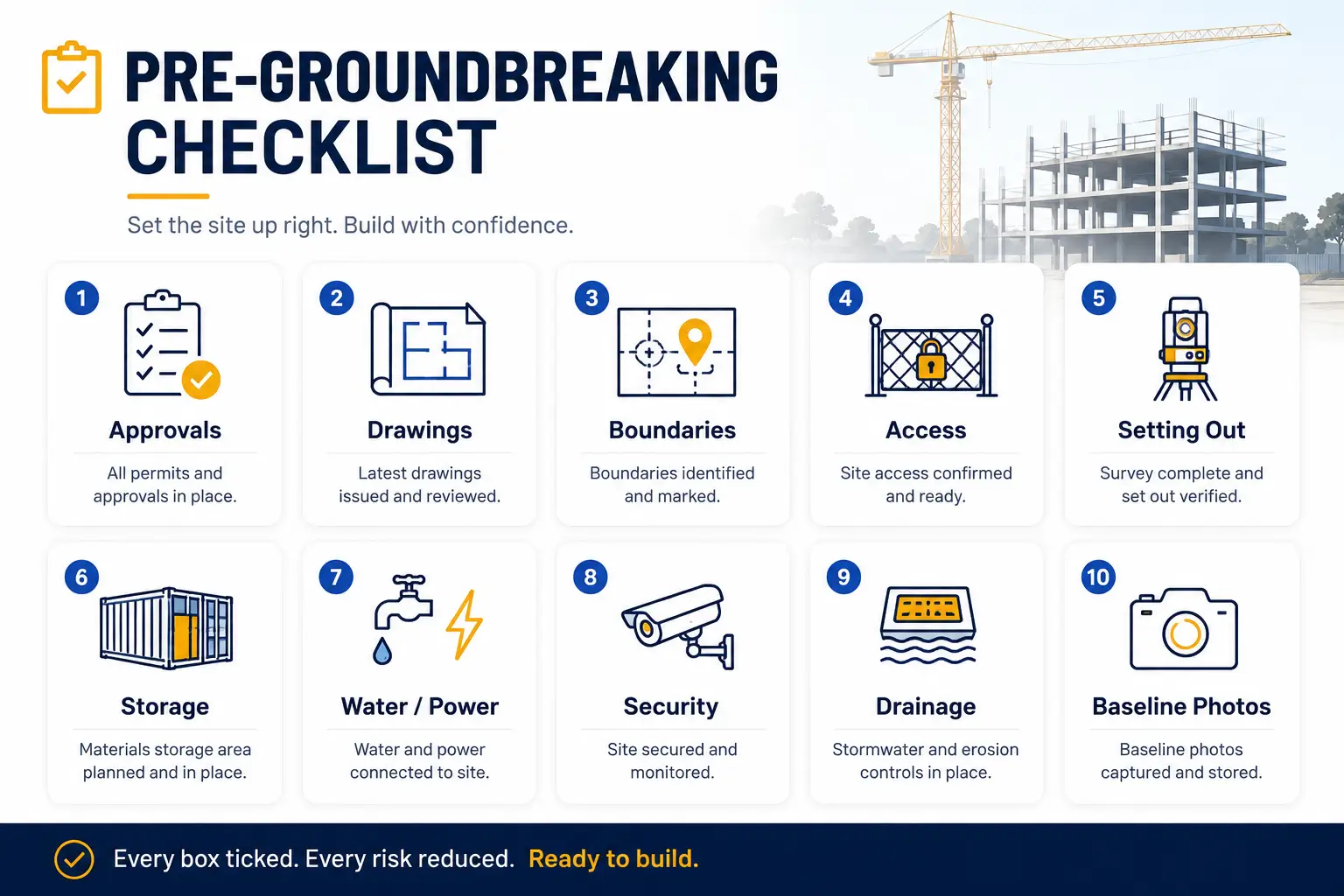
Before construction starts, confirm access and boundaries, required approvals, site information, setting-out arrangements, temporary utilities, storage, drainage, safety, security, waste handling, and a clear mobilisation plan. Good site preparation prevents avoidable delays and losses.
Confirm you are ready to build
Don't confuse clearing land with being ready for construction. Confirm applicable approvals, current drawings, responsible project personnel and the initial work sequence before mobilising labour and materials to site. Starting groundwork simply because a contractor is available is one of the more expensive shortcuts a remote owner can take.
Check boundaries, access and site conditions
Know the exact site limits and the access route heavy vehicles will use. Identify drainage paths, neighbouring structures, overhead or underground services, and any areas that may flood or become inaccessible in rain. Technical site investigations --- soil testing, for example --- should be handled by appropriately qualified professionals where the project requires them.
A boundary dispute discovered after excavation has started is far more expensive and disruptive to resolve than one caught during a site walk beforehand. Where boundaries are unclear, resolve this before mobilisation, not alongside it.
Plan setting out and benchmarks
The building must be positioned from approved information, not guesswork or a rough tape measurement. Confirm who is responsible for setting out and how reference points and benchmarks will be protected once excavation begins. Errors made at this early stage can affect setbacks, alignment and the entire structure, and are far cheaper to catch before the first block is laid than after.
Prepare storage and material control
Decide in advance where cement, reinforcement, blocks, aggregates, roofing products and finishes will be stored on site. Protect materials from water, theft, damage and accidental mixing between batches. Create one clear receiving process: who accepts deliveries, who counts or checks them against the order, who records the evidence, and who reports discrepancies immediately rather than days later.
Arrange temporary needs
Plan water, electricity or alternative power, sanitation, worker access, basic site security and first-response arrangements before the workforce arrives. Also define waste and excavation spoil areas so the site does not become disorganised from day one --- a disorganised site is harder to inspect, harder to secure, and harder to explain to a remote owner from a photograph.
Create a pre-start record
Take dated photographs or video of the site, boundaries, access roads and neighbouring conditions before heavy activity begins. Record the initial state clearly. For a remote owner, this baseline becomes the reference point against which every later change, claim or dispute can be understood.
This is also the right moment to note the condition of any neighbouring structures. If a boundary wall or nearby building is already cracked or leaning before your project starts, a dated record protects you against being blamed for pre-existing damage later.
Quick Checklist
-
Confirm you are ready to build
-
Check boundaries, access and site conditions
-
Plan setting out and benchmarks
-
Prepare storage and material control
-
Arrange temporary needs
-
Create a pre-start record
Frequently Asked Questions
**What is the biggest site-preparation mistake? **
Starting physical work before approvals, current drawings, clear responsibilities and site logistics are actually confirmed, rather than assumed.
Should I deliver all materials before work starts?
Usually not. Procurement should match the programme, available storage capacity, site security, supplier lead times and cash flow, rather than arriving all at once.
Do I need a formal soil test for every project?
Requirements vary by site, project size and location. Ask your engineer whether ground conditions on your specific site warrant testing before finalising the foundation design.
Building Remotely?
RBP's VERIFY step can include an independent pre-start site visit to record baseline conditions and confirm that groundbreaking readiness matches what has been reported, before mobilisation begins.
Related Reading
-
How to Choose the Right Professionals for Your Building Project in Nigeria
-
Documents You Should Have Before Starting a Building Project in Nigeria
Sources & Verification
- ARCON - Building Plan Approval guidance --- Official/source page
Editorial note: These articles are educational resources, not legal, architectural, engineering, quantity surveying, or other regulated professional advice. Where specialist judgement is required, readers should engage the appropriately qualified professional.
Have a question about your own project?
Every build is different. Talk it through with us directly.