Protect Your Project
How to Spot Poor Workmanship Early on a Building Project
Spot poor workmanship early by comparing work with approved drawings and specifications, inspecting before work is covered, recording defects clearly, using qualified professionals for technical assessments, and confirming that corrections are closed before the next stage hides them.
Look for patterns, not only ugly finishes
Poor workmanship is not limited to crooked tiles or rough paintwork. Warning signs include repeated rework on the same element, inconsistent dimensions between similar features, damaged materials left on site, poor housekeeping, work proceeding without current drawings in hand, and defects being covered over before anyone has had the chance to review them.
Inspect at the right time
Timing matters more than almost anything else here. Reinforcement, embedded services, waterproofing and other concealed work can become genuinely difficult to assess once the next activity covers them. Ask the project team to identify relevant hold points and any required professional inspections well in advance, not as an afterthought once work has already moved on.
Use evidence that shows location and scale
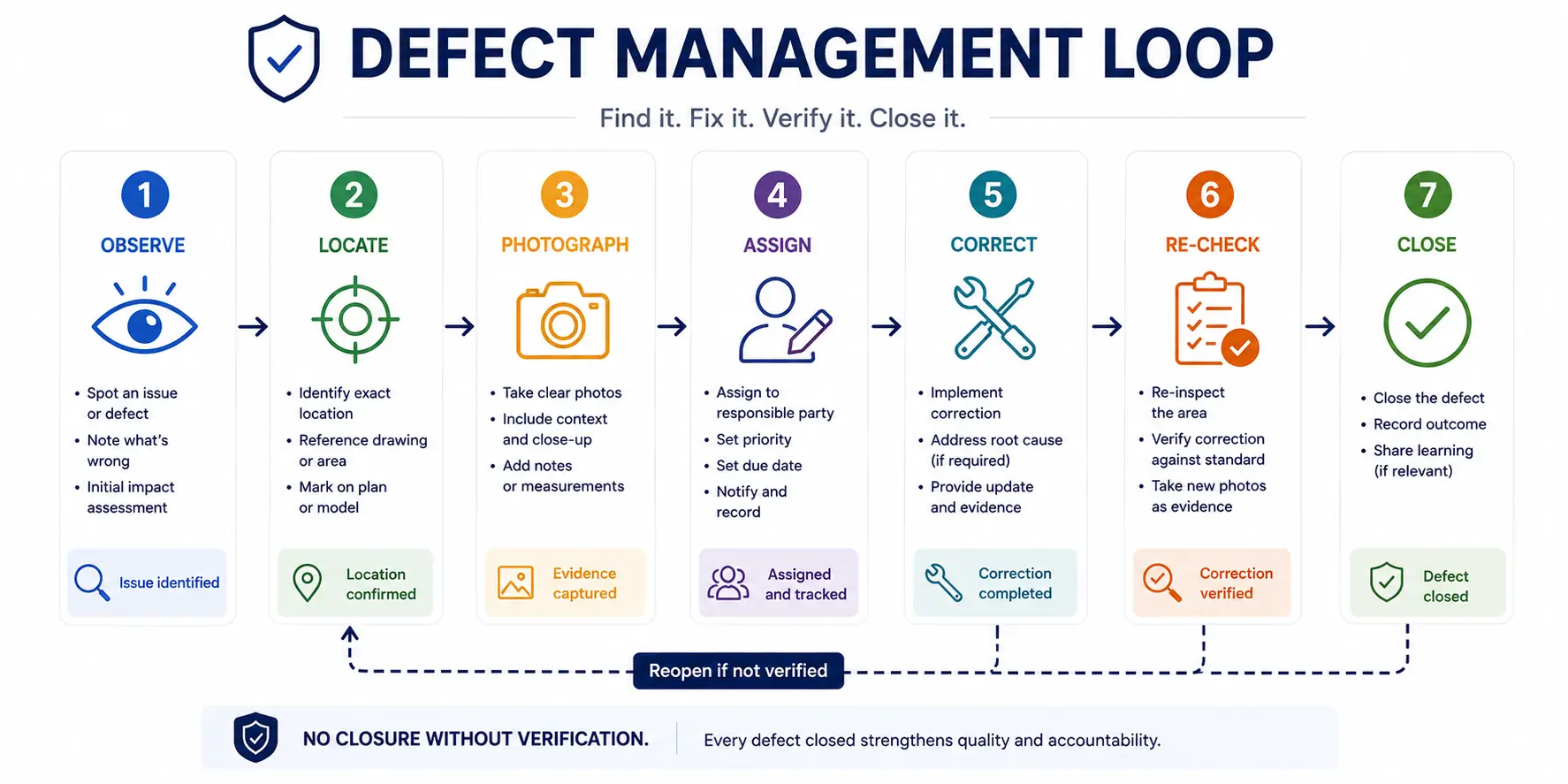
A close-up photo of a crack without any context can be almost useless as evidence. Record the room, grid reference or general location, the date, a wider establishing view, and a close-up together. Add a simple, factual description of what was observed --- and avoid diagnosing structural causes unless the person doing so is actually qualified to make that call.
Including a familiar object for scale --- a tape measure, a coin, a common tool --- in the close-up shot also removes any doubt later about how large the observed issue actually is.
Create a defect register
For each issue, record a reference number, location, observation, evidence, date raised, responsible party, target correction date, current status and closure evidence once resolved. This single habit stops problems from quietly disappearing between one WhatsApp conversation and the next, weeks apart.
Escalate technical concerns correctly
Some workmanship issues are purely cosmetic; others may genuinely affect safety or structural performance. If an observation might involve structural, architectural, services or other specialist judgement, refer it to the appropriate qualified professional without delay. COREN, ARCON and CORBON all provide regulatory or verification resources for the relevant practitioners.
Do not pay to hide a problem
Pressure to keep the programme moving can tempt owners into accepting unfinished correction work just to avoid further delay. Where your contract links payment to completion or quality requirements, document unresolved items clearly before authorising the next payment or the next stage of work to proceed.
Quick Checklist
-
Look for patterns, not only ugly finishes
-
Inspect at the right time
-
Use evidence that shows location and scale
-
Keep a defect register
-
Escalate technical concerns correctly
-
Do not pay to hide a problem
Frequently Asked Questions
Can I diagnose workmanship from photos?
You can identify visible concerns, but photos may not be enough for a full technical diagnosis. Use the appropriate professional whenever a specialist assessment is genuinely needed.
What is the best time to catch defects?
Before the next layer of work conceals them, and while correction is still practical and affordable rather than disruptive.
Should I raise a concern even if I am not sure it is serious?
Yes. Recording it costs little, while an unrecorded concern that turns out to matter can be far more expensive and harder to resolve later.
Building Remotely?
RBP can help coordinate and document visible issues for remote owners as part of its VERIFY and DOCUMENT steps, while technical conclusions remain with appropriately qualified professionals.
Related Reading
-
Common Fraud Patterns to Watch for When Building Remotely in Nigeria
-
Material Substitution: How to Identify and Reduce the Risk on Your Building Project
Sources & Verification
-
COREN - Practitioner verification --- Official/source page
-
ARCON - Architect/Firm verification --- Official/source page
-
CORBON - Builder verification --- Official/source page
Editorial note: These articles are educational resources, not legal, architectural, engineering, quantity surveying, or other regulated professional advice. Where specialist judgement is required, readers should engage the appropriately qualified professional.
Have a question about your own project?
Every build is different. Talk it through with us directly.