Protect Your Project
Why Construction Documentation Matters More Than It Seems
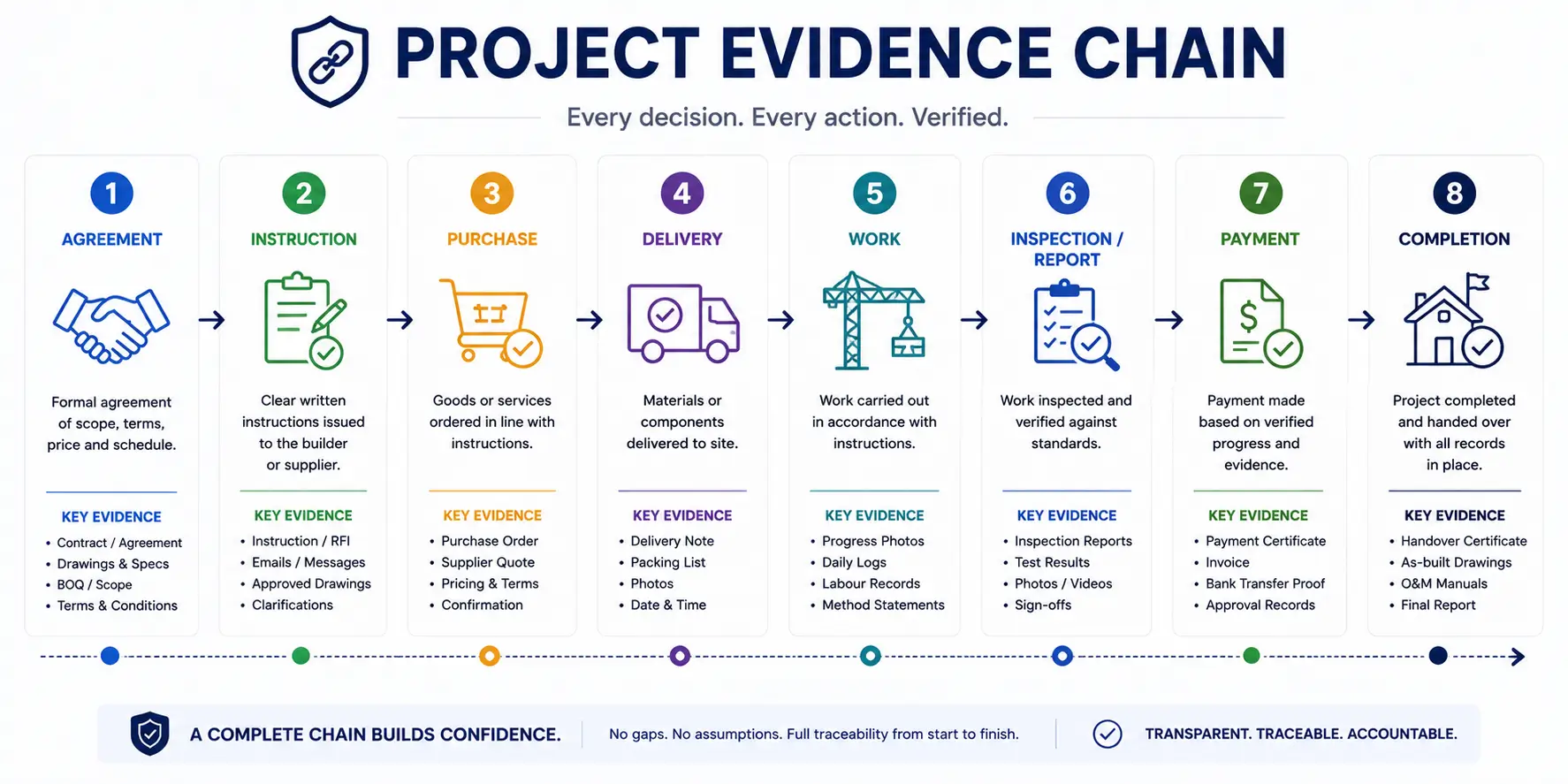
Construction documentation protects memory, money, and accountability. Drawings, approvals, quotations, deliveries, payments, instructions, variations, photos and reports create the evidence needed to understand what was agreed, what happened and what should happen next.
Projects forget quickly
A six-month building project can contain hundreds of individual decisions. People change roles, messages get buried in long chat threads, and memories of the same conversation differ sharply between the parties involved. Documentation creates one shared record that survives all of these changes, rather than depending on any single person's recollection.
Documents connect money to work
A strong record lets you trace any payment back to an invoice, an order, a delivery, a milestone, or an approved variation. Without that link firmly in place, a remote owner may end up knowing exactly how much was spent while having no clear picture of precisely what that money actually achieved on site.
Version control prevents expensive mistakes
Drawings and specifications change over the life of a project. Label the current version clearly and mark superseded files as such rather than deleting them. A contractor working from an old drawing can produce a genuinely painful dispute in which everyone involved sincerely believes they followed the correct instructions.
Photos need context
A photo becomes genuinely useful evidence only once it has a date, a location, a clear activity, and an established relationship to a specific report or milestone. Random gallery images, taken without any of this structure, are extremely difficult to retrieve and make sense of months later when they are actually needed.
Documentation supports dispute resolution
Good records do not guarantee that a dispute will be avoided altogether, but they make the underlying facts far easier to reconstruct when one arises. Preserve signed agreements, notices, approvals, payment records and relevant communications. If a dispute becomes legal, obtain advice from a qualified lawyer rather than attempting to interpret the evidence yourself.
Build a simple project record
You do not need an enterprise-grade system to do this well. Use consistent folders, or a secure platform, organised around Contracts, Drawings, Approvals, Procurement, Payments, Reports, Photos, Variations and Correspondence. Restrict editing permissions where appropriate, and back up critical records somewhere that does not depend on a single device.
A short monthly habit --- confirming that the folder actually reflects what happened that month --- costs a few minutes and prevents the far more painful exercise of reconstructing a year of activity from memory at the end of a project.
Quick Checklist
-
Projects forget quickly
-
Documents connect money to work
-
Version control prevents expensive mistakes
-
Photos need context
-
Documentation supports dispute resolution
Frequently Asked Questions
Should I keep voice notes?
Keep important communications, but convert decisions and approvals into clear written records that can be searched and understood again later, without needing to replay an audio file.
How long should I keep project records?
Retention needs depend on the specific document, contract, and legal context involved. Keep important project and financial records securely, and seek professional advice for formal retention requirements.
Is a shared spreadsheet enough for document control?
For many owner-managed projects, a well-maintained spreadsheet register linked to a cloud folder is a practical and sufficient starting point, provided access is controlled and it is kept current.
Building Remotely?
RBP's DOCUMENT step is built around structured project visibility, because a remote owner should never have to reconstruct a major building project from scattered chats and unlabelled photos.
Related Reading
Editorial note: These articles are educational resources, not legal, architectural, engineering, quantity surveying, or other regulated professional advice. Where specialist judgement is required, readers should engage the appropriately qualified professional.
Have a question about your own project?
Every build is different. Talk it through with us directly.